
Every major technology wave follows a recognizable pattern:
- Core infrastructure appears,
- Early adopters experiment
- Breakout applications reveal the true value,
- The platform becomes indispensable.
Artificial intelligence is following the same arc — but we’re still very early. Despite the noise surrounding model benchmarks, context window sizes, and chat interfaces, the real platform shift hasn’t happened yet. We’re still in the “dial-up Internet” or “pre-App Store smartphone” phase.
The Internet: From Email Utility to Global Platform
When the Internet first began to gain traction in 1991, we saw it as an incremental communication tool — a better version of fax machines and file servers.
Early value propositions were simple:
- Send email
- Transfer files
- Access bulletin boards
Then the web browser arrived.
With Mosaic (1993) and later Netscape Navigator (1994), the web suddenly became visual, navigable, and programmable. Browsers wrapped the raw capabilities of the Internet with a software layer that humans could easily understand and developers could easily build upon. Only then did the true potential become obvious:
- E-commerce
- Social Networks
- Online Media
- Cloud Platforms
- SaaS business models
None of these were obvious in the pre-browser era.
Smartphones: The Real Breakthrough Wasn’t the Hardware — It Was the Software Layer
When smartphones first appeared, they were impressive but limited. They offered:
- Calendars
- Basic Web Browsing
- Simple Messaging
The inflection point came from apps — not the device.
Apple shipped the first iPhone without an App Store. But when the App Store launched in 2008, everything changed. A few early apps became watershed moments because they transformed the phone into a platform:
- Facebook → became the most-downloaded social app.
- Yelp → local business discovery app
- eBay Mobile → early mainstream e-commerce app
- Pandora Radio → one of the first streaming music apps
These were not just apps. They were category-defining experiences that only worked because hardware + infrastructure + software combined into a new platform.
AI Today: Still in the Infrastructure Phase
Right now, the AI industry is focused on:
- Which frontier model is “best”
- Whose context window is largest
- Whose API is fastest
- Which chat UI feels the most polished
This is natural — it’s exactly what we did with early Internet protocols and early smartphones.
The Real AI Platform Shift Will Happen When Software “Wraps” AI
LLMs and frontier models today are the equivalent of:
- The Internet before the browser
- The pre-App Store iPhone
- The smartphone without Facebook, Spotify, Teams, and Slack.
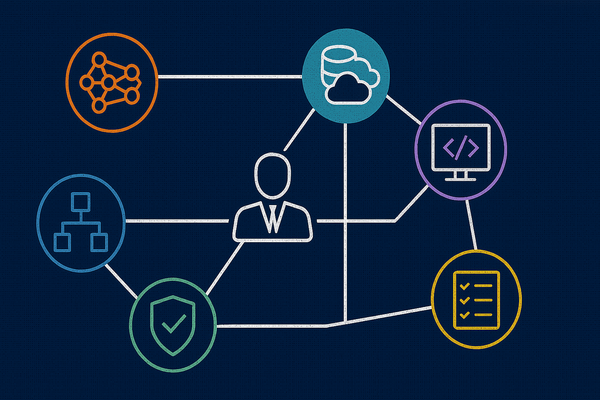
The real transformation will happen when developers, product teams, and enterprises create software workflows wrapped around AI — not just chat windows.
That means:
- Agentic systems that orchestrate multi-step business processes
- Domain-specific copilots embedded inside vertical applications
- Cloud-plus-edge AI systems powering on-premises workloads
- AI-native applications that use context, memory, and tools
- Enterprise platforms that automate entire roles or sub-roles
- Continuous reasoning frameworks that operate autonomously
A Predictive View: What Comes Next
If history is a guide, we can expect the following sequence:
Phase 1 (Now): Infrastructure Build-Out
- Frontier models race
- GPUs and compute arms race
- Cloud AI platforms emerge (Azure AI Foundry, OpenAI APIs, etc.)
- On-prem AI platforms take shape (CUDA, AMD ROCm, JAX, etc.)
Phase 2 (Emerging): Software Wrapping
- Agent frameworks mature
- Context systems (GraphRAG, vector stores, memory layers) standardize
- Enterprises embed AI into existing systems
- Developers build workflows, not chatbots
Phase 3 (Breakout): Watershed Applications
Just like Uber, Instagram, and Google Maps for smartphones, we will see 5–10 breakout AI-native applications that redefine the platform.
They will be obvious in hindsight and totally non-obvious today.
Phase 4 (Ubiquity): AI Becomes Invisible
AI stops being “a feature” and becomes part of how software works everywhere.
Conclusion
Today’s obsession with models and chat interfaces is understandable — but short-sighted. We’re still in the earliest stages of the AI platform shift. The watershed moment will come when software wraps AI infrastructure in ways that reshape workflows, industries, and entire business models.